| marie-hélène le ny |
|
photographist |
|
“Experimental
Chemistry greatly attracted me and I became professor
of Chemistry at the University of Caen where I worked on solid
polymers-which form plastics - and also on soluble polymers described
by specific theories. Once somebody from Grasse -a town in the
south of France renowned for its perfumes industry - came to
my lab, recounting a major problem his company wished to resolve.
They had performed a new “ supercritical extraction”
of vanilla which yielded ultrapure vanilla, but they could neither
manage to dissolve it in water nor incorporate it into food products.
We started the work on the dissolution of this vanilla, without
success. At this time, considering its structure, I had the idea
of applying a theory of soluble polymers and it worked very well
! We managed to introduce this vanilla into food products. The
whole lab was very proud of that success.
Nanoparticles of a 10,000,000th of a meter were prepared in our lab. They are interesting because of their small size: a pin head would contain several billion. These particles have multiple uses, for instance for drug delivery. They may be injected in blood, and they will even travel to the tiny capillaries. When associated with a recognition molecule, they can directly target a site, a tumour or an organ. This targeting allows reducing the medication dosage, and thus the side effects. They may also have a time delayed effect by modulating the diffusion rate of the active product. These particles exist also for hygiene products, for example for purifying water, or for diffusion of perfumes. They may be used wherever efficiency is required, without side effects and may take advantage of time-delayed effects.” |
||
|
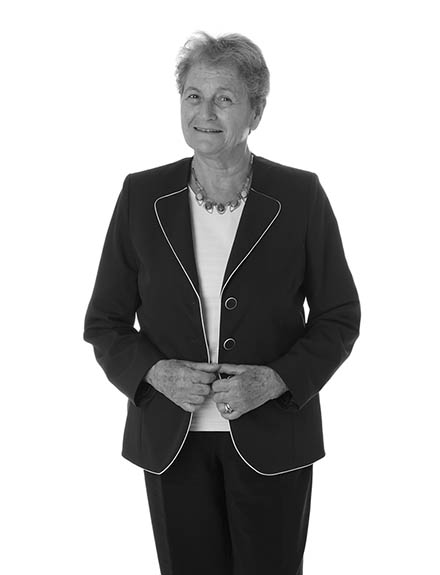
Evelyne Nakache Emeritus professor in chemistry, University of Caen, member of « Femmes et Sciences» association |
|||
|
|
|
|