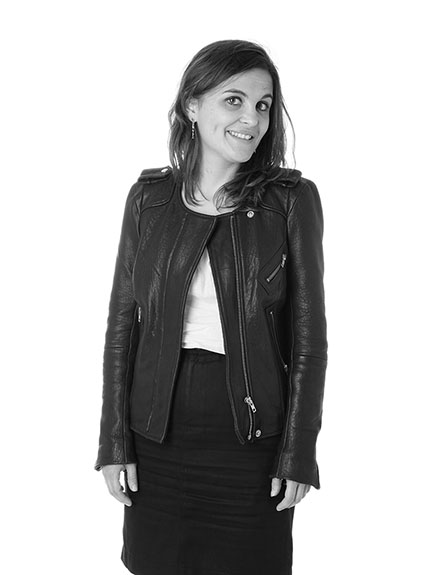
marie-hélène le ny

  Infinités plurielles

 photographist


“My greatest satisfaction as a researcher
was the day I went to a surgical unit with my prototype and surgeons used my camera to detect a tumour. It made me extremely happy to know that the woman lying there having a breast operation would benefit from a technique which would improve her operation and reduce her pain afterwards. Since then, this camera has been adopted by the industry and this technique will replace the horrible and painful method of needle localisation. This justified three years spent writing a thesis on this small camera. I carried out scientific studies to try to improve people's lives, to find technical solutions which increased their daily comfort. After engineering school, I chose to write a thesis which allowed me to go to the surgical unit, to work with doctors and to see the immediate impact of my work.


Participating in the progression of science and developing techniques is very important. This allows humans to better understand the world we live in, to try and explain it and to avoid fear. When we understand something, we fear it much less. Currently, I am an engineer at Essilor, where we improve the sight and visual comfort of those who wear glasses. What I find interesting is something we call the dioptric loop. It is a scientific process which goes way beyond the lens by studying the behaviour of people who wear glasses. This behaviour is then translated into data that will be transcribed mathematically by engineers who can preview a progressive surface, calculated point by point on an optic lens. Prototypes are tested and the dioptric loop reviewed until we obtain a lens best adapted to its wearer.”

Estelle Netter
Project Engineer, Essilor International


previous


 next


 Exit